

 Български
 Ελληνικά
 Polski
 Português
 Română



Introduction
In recent decades, artificial intelligence (AI) and robotics have become increasingly important in modern society, influencing fields such as education, healthcare, business, and the labour market. As these technologies gain more decision-making power, an important question arises: will AI and robotics be able to reduce gender bias and gender discrimination, or will they instead reinforce existing inequalities?
Arguments Supporting the Positive Role of AI and Robotics
On one hand, AI and robotics have the potential to reduce gender discrimination because automated systems can be designed to make decisions based on objective criteria rather than emotions or stereotypes. For example, in recruitment processes, AI systems can evaluate candidates based on skills, qualifications, and experience, without considering gender.
Moreover, AI-powered tools can promote gender equality by providing equal access to education, information, and professional opportunities. In addition, artificial intelligence can help identify patterns of discrimination by analysing large amounts of data, making it easier to detect unequal treatment in areas such as salaries, promotions, or hiring practices.
Arguments Against and Limitations of Technology
On the other hand, AI and robotics are not inherently neutral. These systems are created by humans and trained on data that often reflects existing social biases, including gender prejudice. As a result, AI can unintentionally reproduce or even amplify discrimination.
For instance, if historical data shows inequality between men and women in certain professions, an AI system may learn to favour one gender over another. Furthermore, the lack of diversity among developers and decision-makers in the technology sector can lead to biased designs that fail to consider different perspectives.
Preparing Young Girls for ICT, Robotics, and AI
The Role of Schools
However, for AI and robotics to truly contribute to gender equality, it is essential that young girls are properly prepared and encouraged to access fields such as Information and Communication Technologies (ICT), robotics, and artificial intelligence. From an early age, girls should have equal exposure to digital tools, programming, and problem-solving activities. Schools play a crucial role by offering inclusive STEM education, free from gender stereotypes that suggest technology is a “male domain.”
Increasing self-confidence in young women
The OECD report “The ABC of gender equality in education: Aptitude, behaviour, confidence” reveals, even when boys and girls are equally proficient in mathematics and science, their attitudes towards learning and aspirations for their future are markedly different – and that has a significant impact on their decisions to pursue further education and their choice of career. In general, girls have less self-confidence than boys in their ability to solve mathematics or science problems. Girls – even high-achieving girls – are also more likely to express strong feelings of anxiety towards mathematics.
Mentorship programs
Mentorship programs, female role models in technology, and hands-on experiences with robotics and coding can help build confidence and interest among girls. In addition, families and communities should support girls’ curiosity and ambition in technological fields. Without equal participation in the creation of AI systems, gender bias is likely to persist, as technologies will continue to reflect the perspectives of a limited group.
More women in ICT.
The transition to the digital world has brought us many new and exciting opportunities. However, not everyone has equal access to these opportunities. For some people, the digital world is not yet fully accessible. For others, it is not affordable. And others were not taught the skills to participate fully.
According to UNESCO (2017), women remain significantly underrepresented in STEM fields, particularly in advanced technological domains such as artificial intelligence. Women represent less than 30% of researchers worldwide.
At the same time digital education needs to be in the attention of decision-makers in disadvantaged areas. In the absence of basic digital skills, all the opportunities brought by technology are, for many people and particularly for people of vulnerable groups, nothing more than missed opportunities. The impact of the new technologies will be huge on the people on social assistance and on those who work in the repetitive jobs where they will be replaced by robot.
Girls Code It Better (GCIB) Project
Girls Code It Better (GCIB) is a free, 45-hour project that encourages girls to explore digital creativity and entrepreneurship, focusing on technology and STEM careers. Launched in 2014, it operates in secondary schools, creating inter-school and extracurricular projects. The objective is to mitigate stereotypes of girls in ICT fields by introducing participants to design and creation through technology at an early age. GCIB establishes extracurricular afternoon clubs for middle and high school girls between the ages of 11 and 18. Groups of 20 girls are guided by a coach.
The robots are coming. What do we do with them? RoboHub Bucharest
RoboHub Bucharest is a centre where children, some of them from disadvantaged backgrounds, come into contact with new technologies and learn to use them. Founder of the first humanoid robot and service company in Romania, Ana Maria Stancu was designated, last year, by the international website robohub.org, as one of the 50 women in the field of robotics. She emphasized the importance of learning basic IT skills: “I can’t teach a young person to use Robotic Process Automation if he doesn’t know how to open a laptop”. Because the jobs that are being lost at the moment, in general, are those of people who did not have access to education or technology,” says Ana Maria Stancu. For this reason, Ana Maria Stancu began to advocate for the importance of digital education before decision-makers. An approach, coupled with “grassroots” work, with demonstration sessions and training programs for children and teachers.
She brought in Romania “ESCU” the smiling robot with blue eyes, who welcomes conference participants, as well as “NERO” the dog, who checks the health of crops in the field and notifies farmers when it finds the first sign of disease.
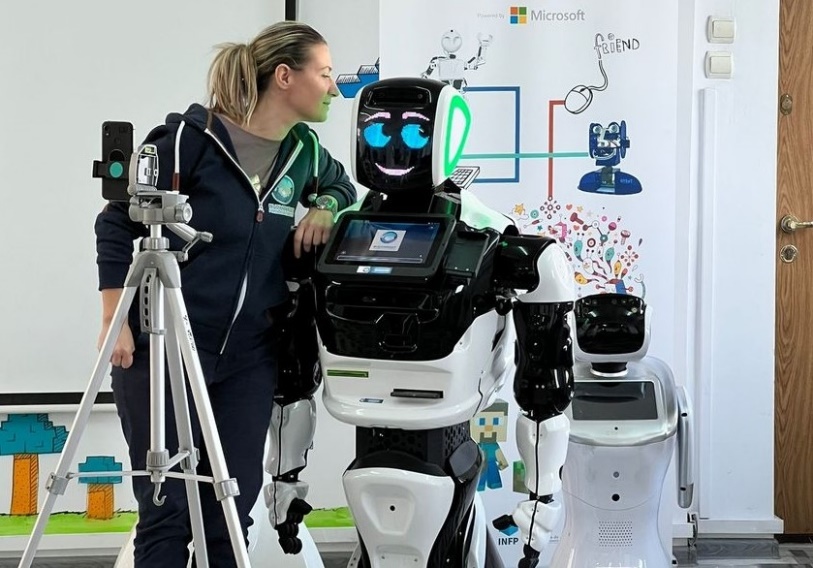
Raising awareness among young girls about EU initiatives for inclusive digitalization.
Even though women make up 51% of the EU population, only 1 in 3 STEM graduates and 1 in 5 ICT specialists are women. Since 2015, the percentage of women working in ICT has not changed much. More efforts are needed in Europe to address this issue.
Digital inclusion is an EU-wide effort to ensure that everybody can contribute to and benefit from the digital world.
Digital skills actions focused on women and girls
The annual European Digital Skills Awards (EDSA) include a ‘Women in ICT Careers’ category. This is dedicated to projects aimed at increasing the number of women ICT professionals and at upskilling women in ICT.
- EU Code Week: a European grassroots initiative, organised annually in October to get especially children and teenagers interested in computer programming and coding, computational thinking, robotics and related digital skills. Code Week encourages girls to participate and highlights women role models in digital careers.
- DigiEduHack is a flagship initiative under the Digital Education Action Plan. It wants to empower digital education enthusiasts to develop creative digital solutions to challenges affecting education systems. While open to everybody, the initiative has a strong focus on attracting youth and girls.
The European AI Office
The European AI Office is the centre of AI expertise across the EU, that promotes the development and deployment of AI solutions that benefit society and the economy.

The AI Office plays a central role in implementing research and innovation policies. It supports the development and use of trustworthy AI, while protecting against AI risks.
Conclusion
In conclusion, artificial intelligence and robotics have the potential to help reduce gender bias and gender discrimination, but they cannot achieve this goal on their own. Their impact depends on how they are designed, the quality of the data they use, and the ethical responsibility of those who develop and implement them. Preparing and empowering young girls to participate in ICT, robotics, and AI is a critical step toward ensuring that future technologies are fair, inclusive, and representative. By combining technological innovation with education, diversity, and ethical standards, AI and robotics can become powerful tools in the fight for gender equality.
Bibliography
OECD (2015) The ABC of gender equality in education: Aptitude, behaviour, confidence. Paris: OECD Publishing.
https://www.right-to-education.org/resource/abc-gender-equality-education
https://digitalcitizenshipmap.eu/initiative/girls-code-it-better
https://digital-strategy.ec.europa.eu/ro/policies/women-digital
https://digital-strategy.ec.europa.eu/en/policies/digital-inclusion